
With the digitalization of the workplace, businesses have had to integrate new technologies into their operational processes. This includes using smartphones, tablets, laptops, and other technologies to facilitate productivity. As a result, managing these technologies securely and efficiently is crucial. As a result, MDM, EMM, and UEM solutions have appeared.
Although many people use these terms interchangeably, they are not synonyms. Each has its own definitional boundary and describes a different stage of evolution in how organizations deal with the management of the devices, applications, and user access. This is why organizations must understand these differences as they relate to their decision-making processes in terms of the solutions that will address their needs.
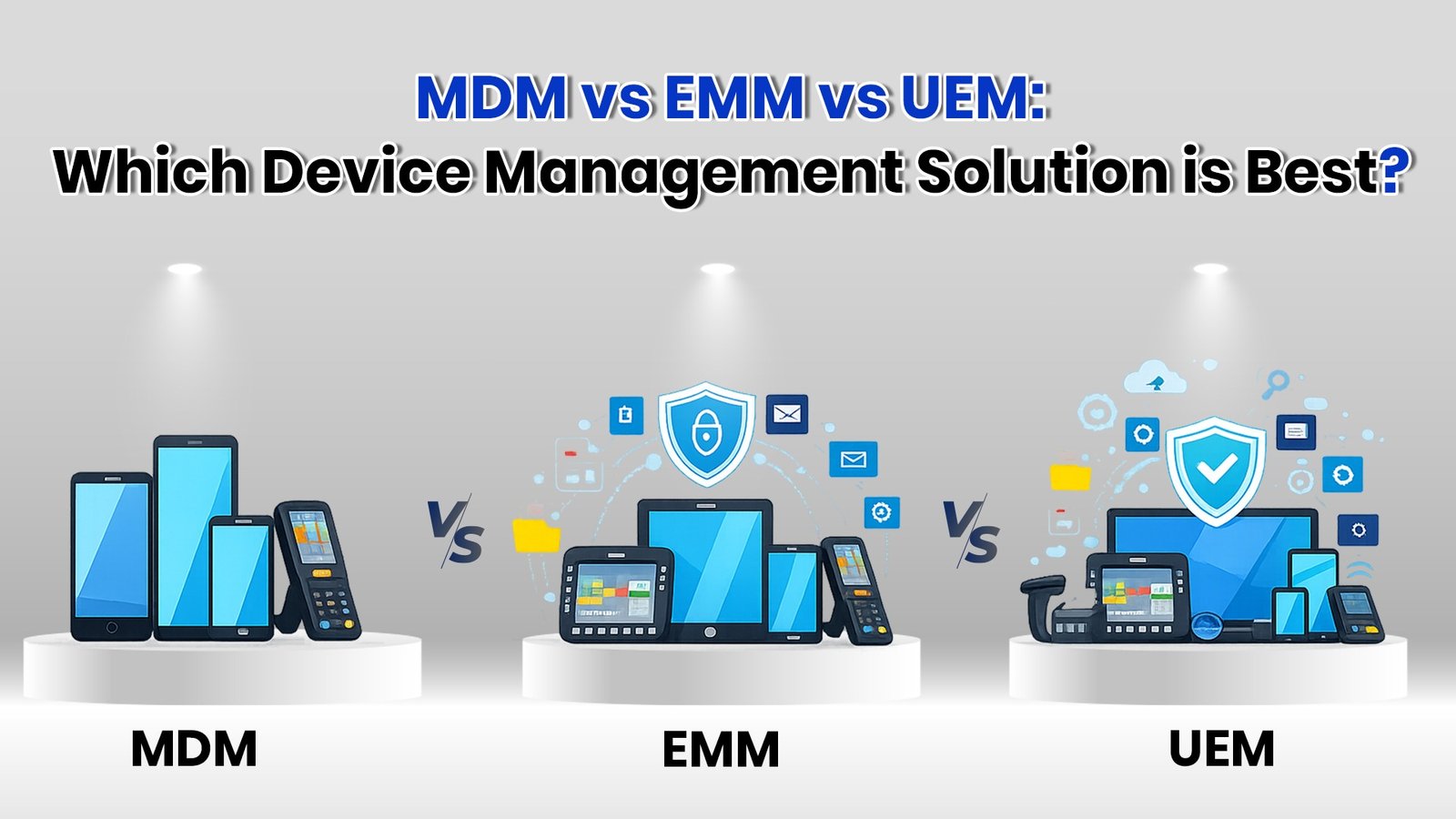
What is MDM (Mobile Device Management)?
Mobile Device Management (MDM) is the primary building block of enterprise device management. Its primary focus is to manage the action that revolves around mobile device management, meaning to secure, and monitor mobile phones and tablets that are utilized in an organization.
From an IT perspective, MDM solutions allow IT to manage device enrolment, manage and/or apply the organization’s security policies, enforce passwords, adjust and/or configure device Wi-Fi and email settings, and adjust and/or manage settings to remotely lock and/or wipe devices in the case of loss or theft. At an organizational level, these are very useful when the organization is in a situation where it has provided employees with company-owned devices.
Regardless, MDM still focuses mostly on control at the device level. At a very minimum, MDM solutions ensure that the security of the device is intact, but, at the same time, little to no control remains at the application or user data level, oversight within BYOD environments.
Key focus of MDM:
- Device security and configuration
- Policy enforcement
- Remote monitoring and control
MDM is best suited for organizations with simple mobility needs and a limited range of devices.
What is EMM (Enterprise Mobility Management)?
The growing need of businesses for mobility beyond control of devices resulted in the creation of EM Enterprise Mobility Management (EMM).
EMM enhances Mobile Device Management (MDM) by incorporating the management of apps and content as well. Organizations can set controls on what apps employees can install, manage updates, protect the corporate data in each of the apps, and can separate the personal and work data on the same device.
EMM enables the IT teams to better manage corporate apps and data in Bring Your Own Device (BYOD) environment without taking control of the user’s personal device.
Key focus of EMM:
- Device management (MDM features included)
- Application management (MAM)
- Secure access to corporate content
Mobile Device Management (MDM) solutions offer less flexibility and security than Enterprise Mobility Management (EMM), and while EMM approaches mobile device management more comprehensively than MDM, EMM approaches mobile device management still singly, and in isolation, from a mobile device perspective, and does not consider more modern
What is UEM (Unified Endpoint Management)?
Unified Endpoint Management (UEM) is, in a practical sense, most sophisticated and most complete out of the three. It is the most evolved from EMM, and is most evolved to address increasingly complex modern information technology (IT) environments.
Most simply, UEM combines management of all endpoints (not just mobile devices), smartphones, tablets, laptop computers, desktop computers, rugged devices, wearables, internet of things (IoT) devices, etc. Also included are identity management, endpoint security, and analytics.
UEM, unlike MDM and EMM, does not focus solely on devices, but rather users, identities, and access, to provide secure and seamless experiences across all endpoints.
Key focus of UEM:
- Unified management of all device types
- Strong security and identity-based access
- Simplified IT operations and visibility
UEM is a perfect fit for organizations that utilize remote work, hybrid environments, and cloud-based functions.
Key Differences between MDM, EMM, and UEM
When thinking about MDM, EMM, and UEM, the main differentiator is scope and capability.
MDM has a device perspective, focusing primarily on elementary security and control. EMM broadens that perspective by incorporating app and data management, making it more effective for mobile productivity and BYOD (bring your own device) situations. UEM goes a step further than that by merging endpoint management under one unified framework.
In short:
- MDM manages devices
- EMM manages devices and apps
- UEM manages devices, apps, users, and identities across all endpoints
MDM, EMM, or UEM:
Determining the choice among MDM, EMM, and UEM is largely a function of organization size, device ecosystem, and security needs.
- MDM may be enough if your organization is using company-owned mobile devices and the security needs are elementary.
- EMM is the right choice if mobile productivity, BYOD, and necessary data and app control are your needs.
- UEM is the most advanced choice for organizations that manage different device types, facilitate remote/hybrid work, and desire centralized control that is more secure. With the increased adoption of cloud services and flexible work models, many businesses are moving directly to Unified Endpoint Management to simplify tool consolidation.
As businesses continue to adopt cloud services and flexible work models, many are moving directly to UEM to avoid managing multiple tools.
Why the Shift toward UEM?
Modern workplaces are no longer limited to mobile phones and tablets. Employees now use laptops, desktops, virtual environments, and cloud apps from multiple locations. Managing all these endpoints separately increases complexity and security risks.
UEM simplifies IT operations by:
- Reducing the number of management tools
- Improving security visibility
- Enhancing user experience
- Supporting scalability and digital transformation
This also explains UEM’s rapid adoption for enterprise endpoint management.
Final Thoughts
MDM, EMM, and UEM are classifications of endpoint management at different epochs of time. Even though MDM and EMM can still be implemented for particular use cases, UEM is the most comprehensive and offers the most future-proof solution for modern enterprises.
It is important for organizations to know the differences between the various endpoints management solutions, as that will enable them to select the endpoint management system that provides the needed endpoint security solution while also enhancing employee productivity.
With the increasing complexity in digital workplaces, endpoint management solutions need to be developed in such a way that it becomes a differentiation factor in the market. Endpoint management solutions become a market differentiator.
MDM Solutions for Business in UAE by VRS Technologies LLC allow organizations to centrally manage mobile devices, enhance data security, and reduce IT workload while supporting secure employee mobility.
For more information, please visit our website at www.mdmsolutionsuae.com or contact us at +971-503241902.